Faculty of Fundamental Problems of Technology
Medical Informatics is an interdisciplinary engineering degree at the intersection of computer science and healthcare, preparing you to build the digital systems that modern medicine runs on.
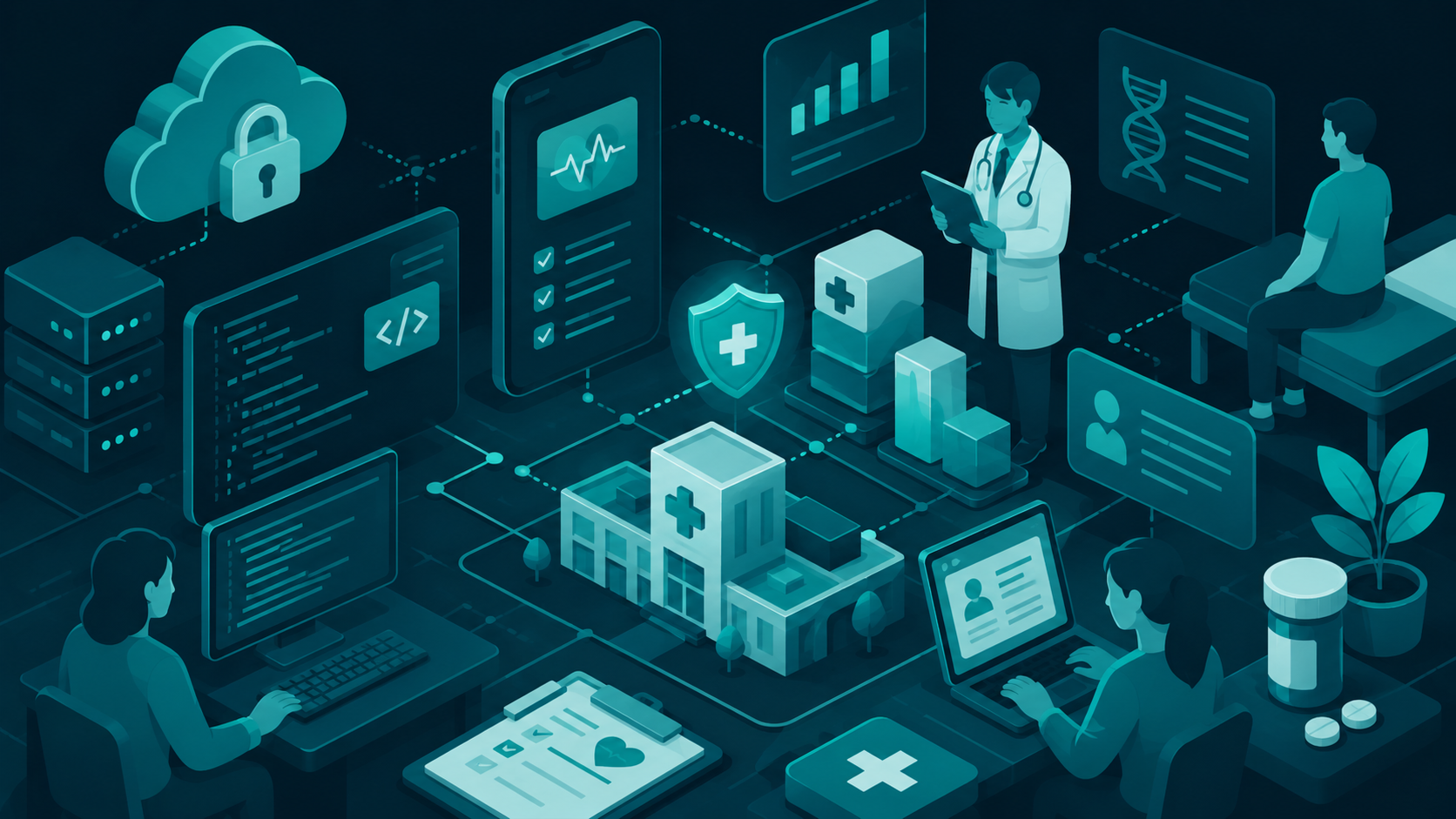
Medical Informatics is an interdisciplinary field combining computer science, information science, and medical sciences, with the goal of managing, processing, and analysing health data to improve patient outcomes and healthcare systems.
"Medical informatics is the interdisciplinary field that studies and pursues the effective uses of biomedical data, information, and knowledge for scientific inquiry, problem solving, and decision making." · WHO / IMIA
From hospital information systems and electronic health records (EHR) to AI-powered diagnostics, genomics, and wearable biosensors, our graduates build the systems that make healthcare smarter, safer, and more connected.
The Polish e-health infrastructure, IKP, e-prescriptions, e-referrals, the P1 platform · was built by professionals exactly like our graduates. Wrocław is one of Poland's leading medtech hubs, with over 200 companies in the sector.
Zapraszamy na studia inżynierskie na kierunku Medical Informatics na Politechnice Wrocławskiej. To nowoczesny, interdyscyplinarny program łączący informatykę z medycyną. Otwórz drzwi do kariery w digitalnej transformacji ochrony zdrowia w Polsce i Europie. Niniejsza strona, materiały oraz sylabus są prezentowane po angielsku. Studia prowadzimy w całości w języku angielskim.
✦ Zajęcia w języku angielskimWe invite you to study Medical Informatics a modern, interdisciplinary engineering programme at Politechnika Wrocławska. The programme is conducted fully in English, preparing you for a career at the intersection of technology and healthcare across Poland and Europe.
✦ Programme fully in EnglishOur graduate is an IT specialist with deep domain knowledge in healthcare, an engineer, analyst, and health informatics expert in one. They move fluently between the worlds of software, clinical data, and medical regulation.
In modern healthcare, technology alone is not enough. Our graduates learn to communicate fluently across specialisation fields: bridging the gap between clinicians, engineers, statisticians, and policymakers.
Translate technical concepts for clinical staff, and clinical requirements into precise engineering specifications: fluently and without loss of meaning.
Coordinate project work across medicine, software, statistics, and regulation: the essential skill for delivering real-world healthcare solutions.
Communicate findings, proposals, and technical results clearly to diverse audiences: from hospital boards to international research conferences.
"In today's healthcare ecosystem, the most valuable professional is not the one who knows the most: it is the one who can make different specialists understand each other."
Medical Informatics is a young, dynamic, and genuinely difficult discipline: still defining itself in Poland and across Europe. It is not for everyone. But for ambitious students willing to sit at the intersection of two demanding worlds, it offers a career at the very frontier of what technology can do for human health.
This is a field under construction. Standards are still being written, regulations are evolving, and the tools are changing faster than any curriculum can fully capture. You will need to be comfortable with ambiguity, eager to learn continuously, and capable of working where no clear playbook exists. That is precisely what makes it exciting.
Annual overview of the most innovative companies and projects transforming Polish healthcare through technology. Where our graduates are already making an impact.
The EU's landmark framework for sharing health data across Member States: enabling research, innovation, and better care. Building and operating EHDS-compliant systems is a defining challenge for the next generation of medical informaticians.
From Warsaw to Wrocław, a rapidly expanding cluster of health-tech startups, hospital IT providers, and CROs are creating demand for specialists who combine deep technical skills with clinical literacy: faster than universities can produce them.
Machine learning, foundation models, and computer vision are not distant promises: they are already in clinical pipelines. Understanding them, validating them, and deploying them responsibly is the core challenge of medical informatics today.
Deep learning models analyse whole-slide pathology images at scale, detecting tumour margins, grading cancers, and flagging rare findings with accuracy matching: and in some cases exceeding: expert pathologists. Medical informaticians build, validate, and integrate these pipelines into clinical workflows.
AlphaFold2 solved the protein folding problem. Generative models now design entirely new proteins for drug targets. Bioinformaticians and medical informaticians work at this frontier: running pipelines, interpreting outputs, and linking molecular findings to clinical phenotypes.
The majority of clinical knowledge lives in unstructured text: discharge summaries, radiology reports, clinical notes. Large language models and NLP pipelines extract diagnoses, medications, and outcomes from free text, enabling population-scale research and real-time clinical decision support.
A model that predicts sepsis 6 hours early is useless if no clinician can trust it. Explainability: understanding why an AI system made a decision: is not just a technical nicety. Under the EU AI Act, high-risk AI systems in healthcare must be transparent, auditable, and explainable. Medical informaticians are the professionals who make that happen: designing interpretable models, building validation frameworks, and translating model behaviour into clinical evidence.
Life Sciences & Healthcare is one of Poland's fastest-growing sectors. Medical Informatics graduates are among the most sought-after professionals across the entire healthcare ecosystem, in Poland and across Europe.
Medical Informatics is a young discipline in Poland — our first graduates entered the workforce only recently, so many alumni are still early in their careers or completing further studies. You can explore their professional pathways through the national graduate tracking portal: ELA · ela.nauka.gov.pl ↗
Medical Informatics at PWr is driven by researchers combining deep scientific expertise with a passion for real-world healthcare impact.
The programme runs for 7 semesters (3.5 years) and awards the title of Inżynier (Engineer). At least 40% of teaching hours are practical: laboratories, design projects, and a mandatory professional internship.
Download the full study programme including all courses, ECTS credit breakdown, learning outcomes, and semester plan for Medical Informatics (1st cycle, engineering degree) at PWr W11.
Download Programme PDF →Join a programme that combines rigorous technical training with real-world clinical impact. Your future begins at Politechnika Wrocławska.
Interested in the Medical Informatics programme, have questions about admission, or want to learn more about our research? We're happy to hear from you.